Postado em: 13 January, 2026
Marcelo Perilo, specialist in Monitoring and Evaluation from the SETA Project, tells us his experience in INEP’s confidentiality rooms
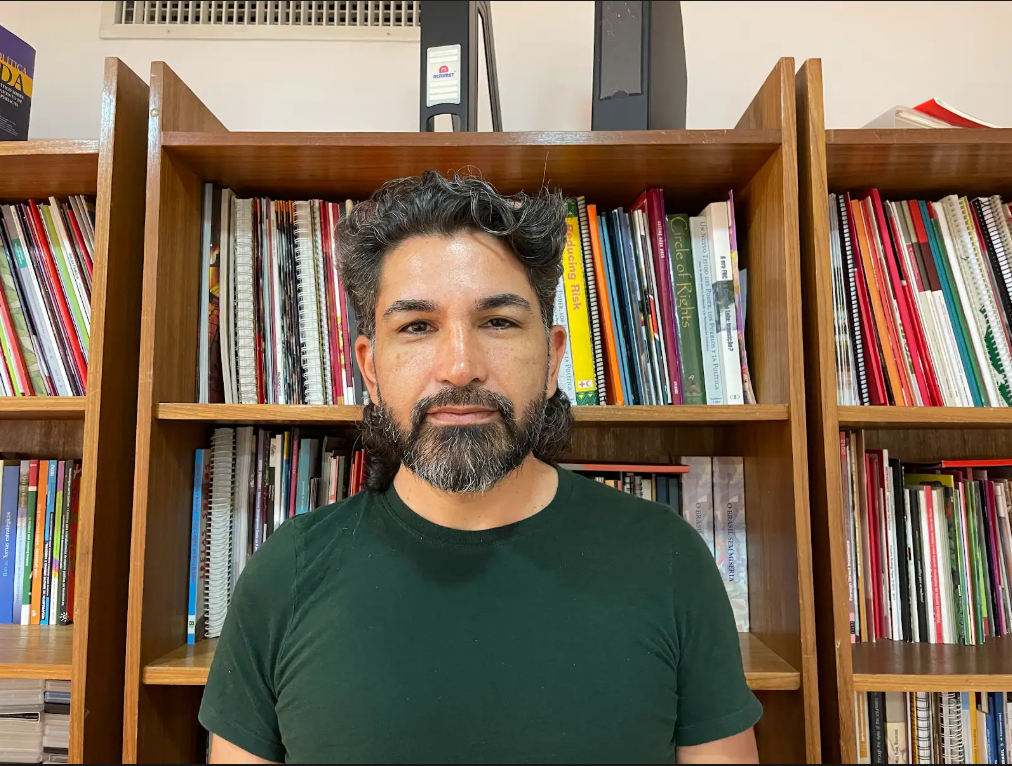
Anthropologist Marcelo Perilo explains the adopted protocols for accessing the databases in INEP’s confidentiality rooms.
Working towards racial equity in education, the SETA Project conducts research and promotes political advocacy, training programs, and mobilization campaigns. To achieve its research and political advocacy goals, the organization has developed a detailed process for data collection.
To understand this process, we have interviewed Marcelo Perilo, a specialist in Monitoring and Evaluation for the SETA Project. The anthropologist details the protocols adopted when visiting the National Institute of Educational Studies and Research Anísio Teixeira’s (INEP) confidentiality rooms and the importance of being able to access the information in the institute’s database. Check out the interview.
1. How was the experience visiting INEP’s privacy rooms, and what can you point out from this visit?
Brazil is an international reference for both its production and dissemination of education data. Many researchers from several countries have even come here to study our data. A large amount of this information is available online and on unrestricted database websites. For example, the Elementary Education Census and the Basic Education Assessment System (SAEB) are available on INEP’s website, and people can access the site at any given moment. However, INEP’s Protected Data Access Service (SEDAP) makes additional data available via in-person visits, which the online databases do not offer.
Therefore, it is only via a visit to the confidentiality rooms that we will gain access to additional and important information to understand and analyze education in Brazil more deeply and robustly. Especially, for initiatives such as the SETA Project, which aims at having an intersectional analysis of its data, to connect gender, color, race, and territory, for example.
2. For the SETA Project, what is the importance of accessing INEP’s access rooms with protected data?
To analyze basic education with greater precision, especially the students’ educational trajectory, and interpret everything that is not feasible when accessing the online databases.
We have access to information on several aspects associated with the students, the classrooms, the schools, the teachers, and the school administration. Therefore, it is possible to learn more about several topics, including, for example, the current infrastructure in the schools, the profile of the administrative personnel, and the teachers. And this is from the school census; however, there are other databases available.
We can analyze this data and its cross-linking data to make it possible to access, view, and consider its analysis from an intersectional perspective. Therefore, we can interpret the data associated with basic education in such a way that it promotes the comprehension of racism’s connections in basic education to other oppressions, such as those related to gender.
3. Which security protocols were adopted during the data collection and the analysis of the confidential data?
INEP recommended a series of procedures so that there is technical feasibility for consulting the data in the confidentiality rooms, and ethical procedures, with the end goal of keeping data maintained in compliance with the General Data Protection Law (LGPD). Firstly, it is necessary to submit a project that proves the theoretical and technical feasibility of the data collection proposal. Once the project has been approved, you must schedule a visit to a confidentiality room in Brazil. After the visit request has been accepted, a researcher will enter the room. In the room, no one is allowed to enter with any sort of electronic equipment or anything that lends itself to any type of image, text, or audio recording. They do this because there is a very organized infrastructure to protect data. It is important to mention that, in the confidentiality rooms, we do not have access to the internet apart from the web server with its protected data. Inside the confidentiality rooms, we have access to a computer with a network connected to the database that we have chosen. Therefore, we won’t be able to check any other data, no other web pages, except that which we solicited from INEP.
After the database processing, which is done within the confidentiality rooms, we leave and send an email to INEP requesting the data that we had run while there. The institution will then assess whether the information that we had worked on and the charts that we produced from this data can be extracted from the machines. There is no guarantee that the researcher will receive all the material that was worked on in the confidentiality room.
INEP analyzes it to verify if none of the content ascertained by the researcher compromises the General Data Protection Law. Consequently, only after this analysis will they forward us a set of charts of the research in the confidentiality rooms.
4. Why was INEP one of the chosen institutions for this technical visit?
INEP was selected because it is an institute that effectively produces and safeguards this data. Therefore, be it the School Census, SAEB, other databases, or other research related to education in Brazil, all of this is information that INEP produces. There are other institutions, official or unofficial. However, we chose INEP because it provides access to extremely relevant databases on basic education in the country as a whole.
There are state institutes that produce analyses on education in specific states in Brazil. However, we needed to access general information on education in the country as a whole. In these databases, which contain educational data in the country, we can specify whether we want data put into the categories: state, city, or by school, for example. Therefore, we will be left with both a macro perspective of Brazil and a much more specific and detailed perspective. This data, however, is always within the scope of the same databases, which allow for comparison within the same data set.
5. What is the feeling of being one of the few to have accessed such information?
It is a significant opportunity because access to INEP’s protected data occurs strictly in person. And, if a researcher needs to consult these databases, he or she will need to travel to the confidentiality rooms, which are still scarce in Brazil. Then, oftentimes, one needs to travel to access this data. And one visit for this sort of service cannot happen in less than a week.
Moreover, this business requires significant investment in terms of financial and human resources and logistical strategies to access this data. Fortunately, there are some programs and organizations that can aid in this investment to access this data.
Once one has the opportunity to visit these confidential rooms, it is like having access to a large treasure chest, which is the very protected and restricted education data itself. This task requires a lot of caution and competence, and the researcher’s ability to choose. This is because there is much information, many variables, and many robust databases.
Consequently, if there is no clear focus and direction for the next actionable steps, it is very easy to get lost—this ability to choose results in an enormous responsibility for the researcher. One third and final aspect that I will mention, which stems from my training as an anthropologist, is the idea of considering the unpredictable or, as it is commonly referred to within the field of anthropology, the imponderables as part of the research process.
6. What are the next steps after visiting?
In the confidentiality rooms, the work is intense. It involves analyzing data, prioritizing the variables needed to do the work, and cross-data analysis, since the interpretation of the data is the next step, which occurs outside the confidentiality rooms. Once we receive the graphs that were worked on in the confidentiality rooms, we can analyze these materials adequately to cross-analyze the collected information with the specialized analysis. We are talking about bibliography references, similar research on basic education, and other types of documents. This step will produce a skill, the researchers’ interpretative analysis, because it is at this moment that they cross-reference all of the data coupled with theory to generate never-before-seen knowledge on basic education in Brazil.
I believe that the SEDAP’s service is an extraordinary public policy and that it needs to be valued and promoted in the country. This is a form of recognizing how many initiatives we have in Brazil connected to education that are robust and understood as international references. There should be more confidentiality rooms throughout the country to facilitate the researchers’ visits in the many regions; however, the mere existence of this service is already a huge achievement for those researching education in Brazil.