Postado em: 9 September, 2025
Rio de Janeiro School Leads the Way in Antiracist Education
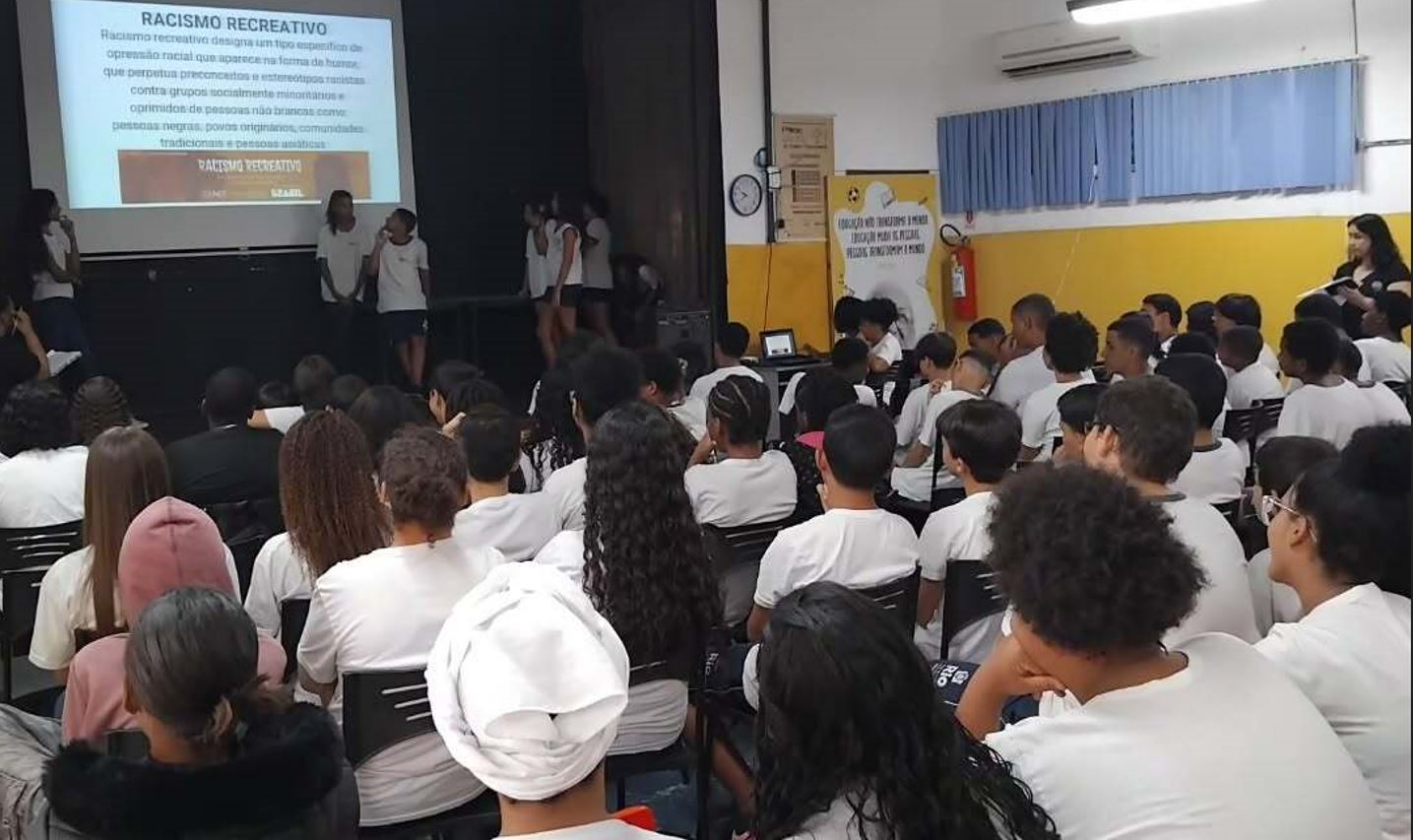
In different subjects, students have access to lessons on African and Afro-Brazilian culture in school.
Law 10.639/2003 makes it mandatory to teach African and Afro-Brazilian history and culture in the school curriculum. However, despite the legislation’s existence, its implementation still faces challenges that involve the entire scholastic ecosystem. In addition individual schools, municipal and state secretaries of education play a central role in defining guidelines, allocating resources, and providing continuous training for professionals working in education. Similarly, the active participation of administrators, educators, students, and their family members is essential to guaranteeing its effective implementation.
On the opposite side of this concerning scenario, the Municipal School Ambassador Barros Hurtado, located in Cordovil, a neighborhood in the north zone of the city of Rio de Janeiro, did excellent work with regard to the implementation of Law 10.639/2003. With a little over 300 students, divided among the sixth and ninth grades of basic education, the school’s mission is to be an institutional model in teaching anti-racist education.
“Antiracist education is the establishment of pedagogies that confront racial discrimination, tailored to educating students on ethnic-racial relationships. In addition to this, the goal is to give black people pride in their legacy, intellectual knowledge, and struggles. From another perspective, white people can comprehend the participation and the importance of black people’s history and culture and how they exist, live, and relate to one another, notably black women. It is urgent to include their civilizing values in the school curriculum and confront the myth that we are all equal in a post-racial society,” Mônica Aniceto, a Portuguese teacher at the school, says.
For Luciana Ribeiro, specialist in education from the SETA Project, antiracist pedagogic practices need to be accompanied by training programs for teachers and administrators, with the aim of adequately addressing this theme within schools. “The School Guidelines for Education for ethnic-racial relations (EERR) and the National Plan for EERR provide clear orientation. In this sense, we understand that another important step for daily antiracist practices at school is through knowledge – in other words, altering the representations of the content that have historically presented stories, achievements, and victories related solely to a social group that mirrors colonization and uses white people as the sole reference”, the specialist reinforces.
Achievements in federal and state schools
Good work developed by the school’s entire faculty body achieved good results. In 2024, the Municipal School Ambassador Barros Hurtado has 43 certifications from federal and state institutions, such as Pedro II, FAETEC, CEFET, the Federal Institute of Rio de Janeiro, and SESI School. The positive results instill, in the teacher Mônica Aniceto’s heart, expectations for a better future. “These children live in Cordovil or surrounding areas, which is significant. We often only see the neighborhood on television due to the violence that surrounds it. However, these students possess everything they need to lead our society towards greater equity. There is no doubt in my mind that we are fostering more conscientious and critical citizens” the teacher comments.
According to the Development Index for Basic Education (IDEB), in 2023, the municipal school network of Rio de Janeiro attained the best results in its historical record. The growth between 2021 and 2023, in the first years, was the largest increase recorded among the evaluations since 2009. The indicator measures the education quality in Brazil.
Nevertheless, despite these improvements, there are still challenges in teaching in the municipality of Rio de Janeiro. “While students are the drivers of these indices, we won’t fully support them unless we also consider the educators – the producers of this data. When we fight for equity, we fight for diversity of thought and history. Furthermore, the quality of teaching traverses the teacher’s quality of life on the ground at the school. It is necessary to take concrete action that protect the physical and mental health of the educator”, Mônica says.
The school as a garden of possibilities
The intellectual work of American antiracist activist, bell hooks, perfectly describes the work developed by professors Elisabete Macedo and Clarissa Raso, Spanish and science teachers, respectively.
During Spanish class, Elisabeth, who has been an educator for over two decades, introduces the students to black and indigenous figures from Hispano-American culture, including politicians, writers, and artists. “During class, we notice that the students identify more with the life stories of the individuals presented. From this insight, we observed that they began to have more pride in themselves”, the educator comments, who hopes that the students develop a critical conscious of the diverse individuals and cultures that make up Brazilian society.
Clarissa Raso, science teacher, utilizes creativity to include the topic in the classroom. “Whenever a theme can be further contextualized with history, culture, and customs and Afro-Brazilian contributions, I seek to integrate them into my classes. When teaching astronomy, I include storytelling, narratives, and discoveries made by African and indigenous groups. While teaching evolution, I work with the origin of humanity on the African continent, exploring the physical and genetic characteristics that explain the adaptation and survival of different populations around the world. In botany, we explore the knowledge of medicinal plants, investigating their traditional usage and their current relevance, recognizing the importance of ancestral knowledge” she explains.
Important actors
Ninth-grader Izaac Márcio Feitosa, 14 years old, asseses the school’s work, understanding that it is crucial to understand how racism is structured and originated in order to combat it effectively. “Even if it is the school’s duty to be antiracist or against any type of prejudice, I feel privileged to have access to antiracist education, because I know that the majority of my peers don’t have access to important projects such as the ones we have here”, says the student.
Finally, the teacher Mônica Aniceto highlights that antiracist education built on equity makes it possible for the students to understand that they are the most important actors in these spaces. “They understand that everything there was done for them and by them. The black student feels like they are in an environment that could bring them value, and the white student understands their privileges. This work brings on both responsibility and a desire to produce concrete changes”, she concludes.