Postado em: 4 September, 2025
Conference “Learning Experience on Racial Equity 2030” hosts Anielle Franco, Ynaê Lopes, and Joana Oscar
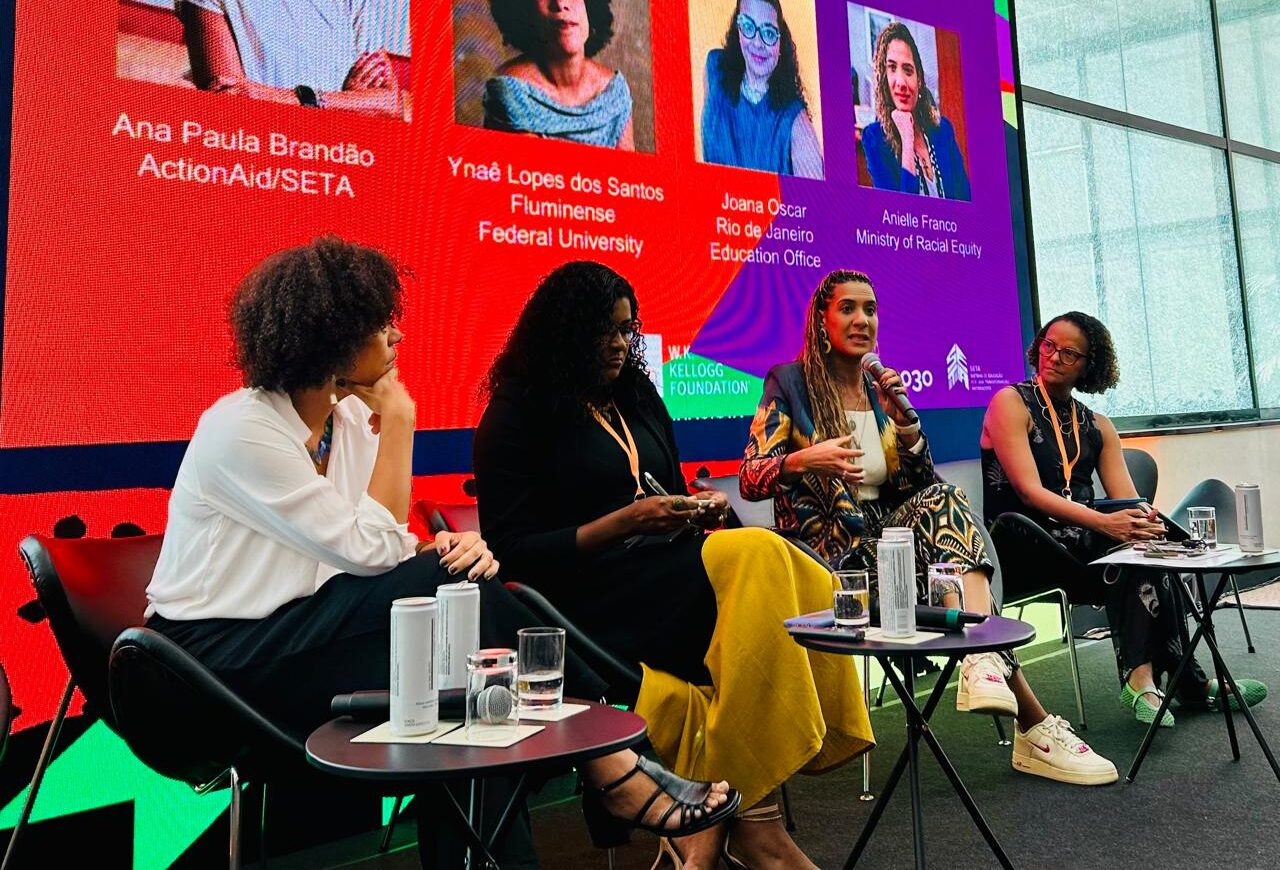
The event, promoted by the Kellogg Foundation in partnership with the SETA Project, features panelists discussing racial equity.
Throughout the four days, the event “Learning Experience on Racial Equity 2030”, promoted by the Kellogg Foundation, in partnership with the SETA Project, gathered specialists in São Paulo, SP, to discuss topics related to racial equity. In addition to the guests, the delegation of the International Foundation was also present, as well as all the organizations that comprise SETA Project’s alliance – ActionAid, Ação Educativa (Educative Action), National Campaign for the Rights to Education, CONAQ, GELEDÉS, Makira-E’ta, and UNEAfro Brazil.
The first panel of the conference, beginning on April 28th, welcomed Anielle Franco, Minister of Racial Equality, Joana Oscar, from the Administration of Ethnic-Racial Relationships (GERER), from the Secretariat of Education for Rio de Janeiro, and the historian Ynaê Lopes.
Mediated by Ana Paula Brandão, SETA Project’s administrator and ActionAid Brazil’s Program Director, the roundtable “Historical Contextual Scenarios of Race, Education, and Youth in Brazil” opened the event, which was a part of the agenda for the “2030 Racial Equity Challenge”, a W.K. Kellogg initiative. The SETA Project is the only Brazilian organization that has been funded by the international institution.
Challenges for the application of the laws 10.639/03 and 11.645/08
During the panel discussion, Joana Oscar, of GERER, addressed the lack of application of Laws 10.639/03 and 11.645/08, which make teaching both Afro-Brazilian and Indigenous history and culture obligatory. “It has been over 20 years since teaching African, Afro-Brazilian, and Indigenous history and culture in the school curriculum for primary education has been made obligatory; however, the Municipal Secretary of Education began implementing this task only in the last five years. This means that 18 years have gone by before any institutional stance was taken”.
Joana emphasized that the Secretariat still sought, through legislation, to create frameworks for the schooling curriculum, teacher training programs, intersectional pedagogic programs, evaluation, monitoring, and resources. “Given this, in these five years, we have been employing activities in all of these different frameworks, questioning the area of the curriculum, how the professional will deliver the content, in addition to us discussing continued training programs, and what the teaching training material will be”, she states.
Education as the most effective tool for racial equity
Historian Ynaê Lopes introduced the historical context to the guests on slavery in Brazil and addressed the relationship between racism and education. “We are a country that was forged not only by enslavement, but also by the trafficking of enslaved Africans. It is essential to specify that a large part of Brazilian wealth was built on the buying and selling of Africans. In addition to this, we were the last country to abolish slavery in the Americas, which was a choice made when Brazil was born and became a sovereign and independent nation on the seventh of September 1822”, she analyzed.
For the specialist, for a long time, education was a means to perpetuate racism in Brazil, and, given this scenario, she believes that the most efficient tool for racial equity is anti-racist education. “The Law 10.639 has a fundamental importance, I think that it can even be considered a small revolution in education in Brazil, because it is the result of this huge struggle from the black population for equity and justice in the country, which, in a very perverse way, we were removed from the construction of the nation’s history. At best, black people appeared during the era of ‘didactic gringo’ enslavement”, she states.
The importance of the black movement’s historical struggle for racial equality in Brazil.
During her speech, Ana Paula Brandão commented on racial inequality in education in Brazil. According to the professional, this is a complex issue, with data that shows that the black population has less access to quality education and is less likely to finish high school and higher education, for example. “This disparity arises in several aspects, from the schooling infrastructure to the teaching quality”, she remarks. For Ana Paula, the historical struggle of the black movement in Brazil provided strides. The Legal Framework is one of those achievements that attempt to tackle the vast educational inequalities in Brazil.
The Minister highlights the school dropout scenario
During her presentation, Minister Anielle Franco emphasized how school dropout is predominantly concentrated among black youth, around the peripheries of cities, favelas, or more vulnerable territories; and she reinforced the importance of Law 10.639, which makes teaching Afro-Brazilian and Indigenous history and culture obligatory in the school curriculum.
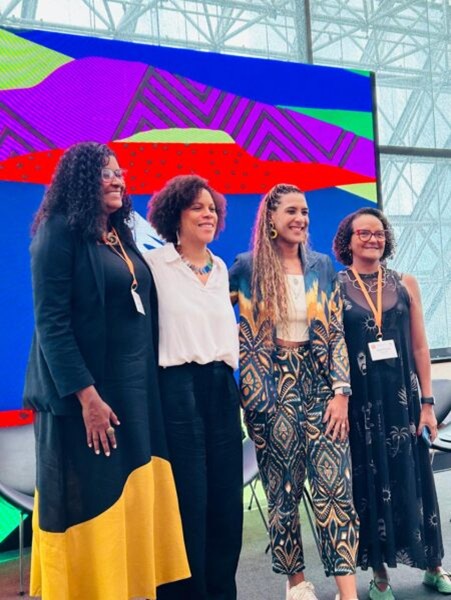
Minister Anielle Franco at the event in São Paulo (Photo: The SETA Project)
“Oftentimes, anti-racist education is learned not only in books or in schools. We also learn it from being born black and residents of the favela, in our day-to-day life. So, regardless of where I am working, I always reinforce to people that they are on my side in that this country will only successfully have racial democracy when we can make it so that our black population has access to a dignified life. And this means having access to education, health, sports, culture, leisure, and, mainly, making sure that they stay alive, which is what we have been fighting for the most”, the minister reinforced.