Postado em: 9 September, 2025
The SETA Project participates in the release of the National Education Plan’s Antiracist Notebook
The document consolidates guidelines to ensure the new National Education Plan (NEP) is an instrument to combat racism.
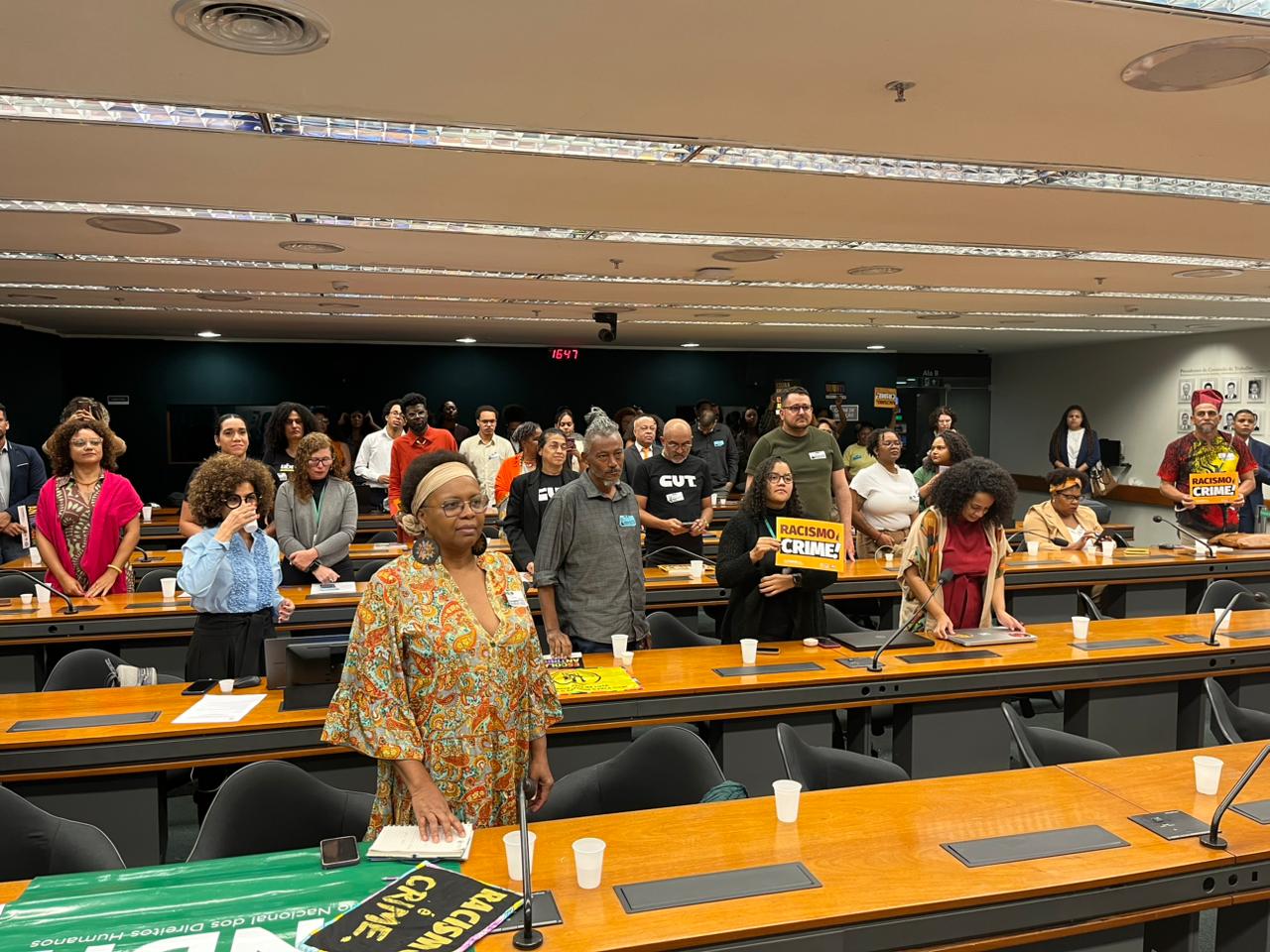
The Federal District was the meeting place for the release of the NEP’s Antiracist Notebook on July 1st. The document consolidates guidelines to ensure the new National Education Plan is a genuine instrument in combating racism and promoting racial equity. The SETA Project was represented by Maria Corrêa, an Educational Coordination and Management Specialist.
“The notebook is an essential tool in the fight for a just and equitable education, which values Afro-indigenous history and culture and combats structural racism and ensures public policies based on the effective implementation of laws 10.639/03 and 11.645/08”, says Maria Corrêa.
Parliamentary members participate in the release of the NEP’s Antiracist Notebook
Congress members from the Joint Parliamentary Front on Education and the Joint Parliamentary Front on Anti-racism, representatives of organizations from the black movement and civil society, and researchers and specialists in education for ethnic-racial relations showed up for the NEP’s Antiracist Notebook’s launch.
According to Deputy Dandara Tonantzin (PT-MG), one of the project coordinators, the group’s work, which was responsible for the notebook, is to ensure that it combats racism and promotes racial equity.
“In a country with Brazil’s demographic profile and history, the National Education Plan’s formulations must be associated with the concepts of a truly anti-racist education. This is the prerequisite for the country to finally overcome its civilizing deficit, whose origin is none other than the blight of 300 years of slavery”, says the Congresswoman.
The notebook assembles guidelines so that the National Education Plan (NEP) – valid from 2024 to 2034 – can serve as the model to guide public policies in the area of education. The objective is also to contemplate an education with representativity, valuing black, quilombola, and indigenous education; to strengthen affirmative action policies, such as inclusive training for teachers; and establish public policies for racial equity with goals and a budget.
During the meeting, members of organized civil society had the opportunity to discuss the need for the actual implementation of these laws so that there is quality in education.