Postado em: 4 September, 2025
Gender, Race, and Education are themes discussed at the Conference “Learning Experience on Racial Equity 2030”

The event program had powerful discussions on the future of education and sharing experiences among the participating organizations
Continuing our coverage of the “Learning Experience on Racial Equity 2030” event, promoted by the W.K. Kellogg Foundation in partnership with the SETA Project, this report details additional content discussed during the first day’s program. The conference featured powerful discussions on the future of education, alongside debates focused on racial equity and an exchange of experiences among the organizations.
The panel “The intersections of gender, race, and education for the SETA Project – working collectively to promote an antiracist, inclusive, and equitable education system in Brazil” was a part of the program. It was mediated by Daniela Viera, Liaison Consultant for the SETA Project for ActionAid.
The panel included Cristina Assunção (UNEafro Brazil), Emanuel Herbert (Makira E’ta); Givânia Maria Silva (CONAQ), Tânia Portella (Geledés), Avanildo da Silva (National Campaign for the Right to Education), Ednéia Gonçalves (Ação Educativa – Educative Action), Luciana Ribeiro (SETA Project), and Zama Mthunzi (ActionAid International). During the discussion, representatives from organizations comprising SETA’s alliances shared their stories, experiences, and work from their respective initiatives.
An education system based on the education of ethnic-racial relations
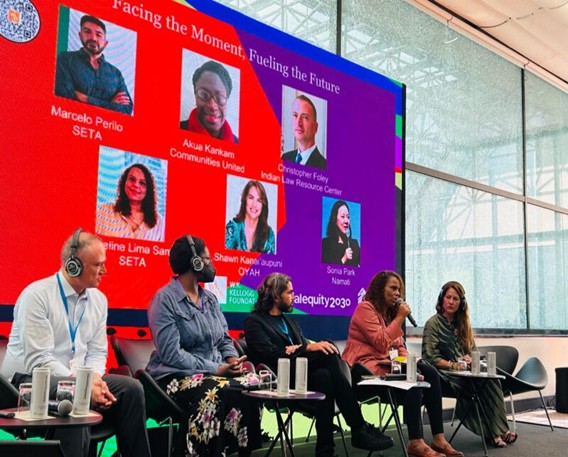
Antiracist education was a key theme at the SETA Project event (Photo: SETA Project)
Cristina Assunção, representative of UNEafro Brazil, commented on the mobilization of black and peri-urban youth through grassroots college-prep courses, one of the institution’s longest-running activities. She emphasized that, “this work was consolidated through a teaching system geared towards education rooted in ethnic-racial relations. Its goal is to reorganize and strengthen the academic trajectories of these adolescents, providing them with tools to access higher education and technical vocational training”, the professional emphasizes. According to Cristina, UNEafro Brazil currently supports 32 grassroots college preparatory courses nationwide.
Collaborative work in favor of systemic change in education
The first day fostered a discussion that focused on other organizations included in the “Racial Equity Challenge 2030”, an initiative from the Kellogg Foundation, which funds the Challenge and the SETA Project. The panel, “Confronting the present, nourishing the future: collaboration for systemic change,” included Shawn Kanai’aupuni (Opportunity Youth), Akua Kankam (Communities United), Christopher Foley (Indian Law Resource), and Sonia Park (Namati). The SETA Project was represented by Jaqueline Santos, Monitoring and Evaluation Manager, and Marcelo Perilo, the organization’s consultant.
The participants had the opportunity to present, through videos and speeches, the context of their work – including their respective projects, results, and experiences – to other conference participants. They also explored how intersectoral collaboration aids in systemic change.
Christopher Foley of Indian Law Resource, an organization dedicated to overcoming the severe issues threatening Indigenous people, highlighted, as an example, the initiative’s operations, the initiative’s operations and their work with a group of young people, which resulted in the creation of the program “Minds Matter”.
“These youth conducted a study of the participatory action to identify the problems within the black community, which are concentrated in mental health. And, as a part of the research recommendations, one of the points identified was that they needed a pathway to have access to psychological well-being. Thus, as a consequence of this suggestion, the partnering hospital helped us to create the program Minds Matter, which offers the opportunity for the youth to work with mental health,” Foley points out.
Historical wealth, inheritance, and resilience from the Afro-Brazilian communities
The first day of the programming wrapped up with a beyond special activity. After a full day of rich and inspiring discussions, all of the event’s participants had the opportunity to take a guided tour of the Afro-Brazil Museum.
The institution, founded in 2004, exalts the contributions of the black population in the formation of Brazilian society and culture, and portrays the wealth from the African and Afro-Brazilian cultural milieu, in addition to highlighting themes such as religion, art, and history.
The guests were welcomed by the group Ilú Obá De Min, which gave a beautiful presentation. Following the presentation, the poet Luz Ribeiro, recited poems. And, lastly, the guests explored the Insitution’s permanent exhibition, which is full of cultural significance and pays homage to the history and resilience of the Afro-Brazilian communities.
Check out the poem “A Woman of Her Word (Mulher de Palavra) recited by Luz Ribeiro:
I am a woman of paper.
I am composed of cellulose and cellulite
I melt easily
I toss myself easily
They wanted me to be agile
I milk, I try
I’m soft with equally flabby breasts
And full bosom
Once placid.
Today, turbulent
My stretchmarks are maps
that go nowhere.
They are marks of a tired acceptance
Of someone who dared to fit in the unfit:
38, straight hair, fashion, media, average…
Failure, I don’t fit within myself.
My world is vast
Size 44/46/48
Fist of steel
Hair standing on end
The embrace insists,
but I change quickly
Solitude persists.
They darkened me and I soured
They wanted me hot,
but I’m burning.
Instantly in 3 minutes
I get cold, you see?
As a woman, my role
Should be to care for my family,
Should be to serve my husband,
Should be to manage 5 kids,
Should be to bear 5 kids,
And still take care of the dogs
Should be to provide pleasure
But I owe, and I don’t deny
And this debt is a doubt
And with this doubt, I’ll leave the payment
Unresolved
I am off the plumb line.
I don’t walk within the lines.
I extrapolate the margins.
I am a scrap of paper
I am just a mark on the sheet of paper
I take risks when I streak the page with poetry
I laugh, yearning to love
In me, it’s only my smile that is loose
Maybe by arms as well.
I allow everything to escape.
What suits me is what remains.
My legs are strong.
The ground is what strips me of
the obsession to fly.
Poems give me wings.
My grammar is symptomatic
I am not in the books
This is why I write stories
The passing of the calendar
marks my trajectory.
I am a woman of paper.
On paper and beyond it.
May God allow me, now
To be a woman of her word.