Postado em: 9 December, 2025
Ancestral Identity and Resistance: Learn more about Indigenous Tattoo Symbols
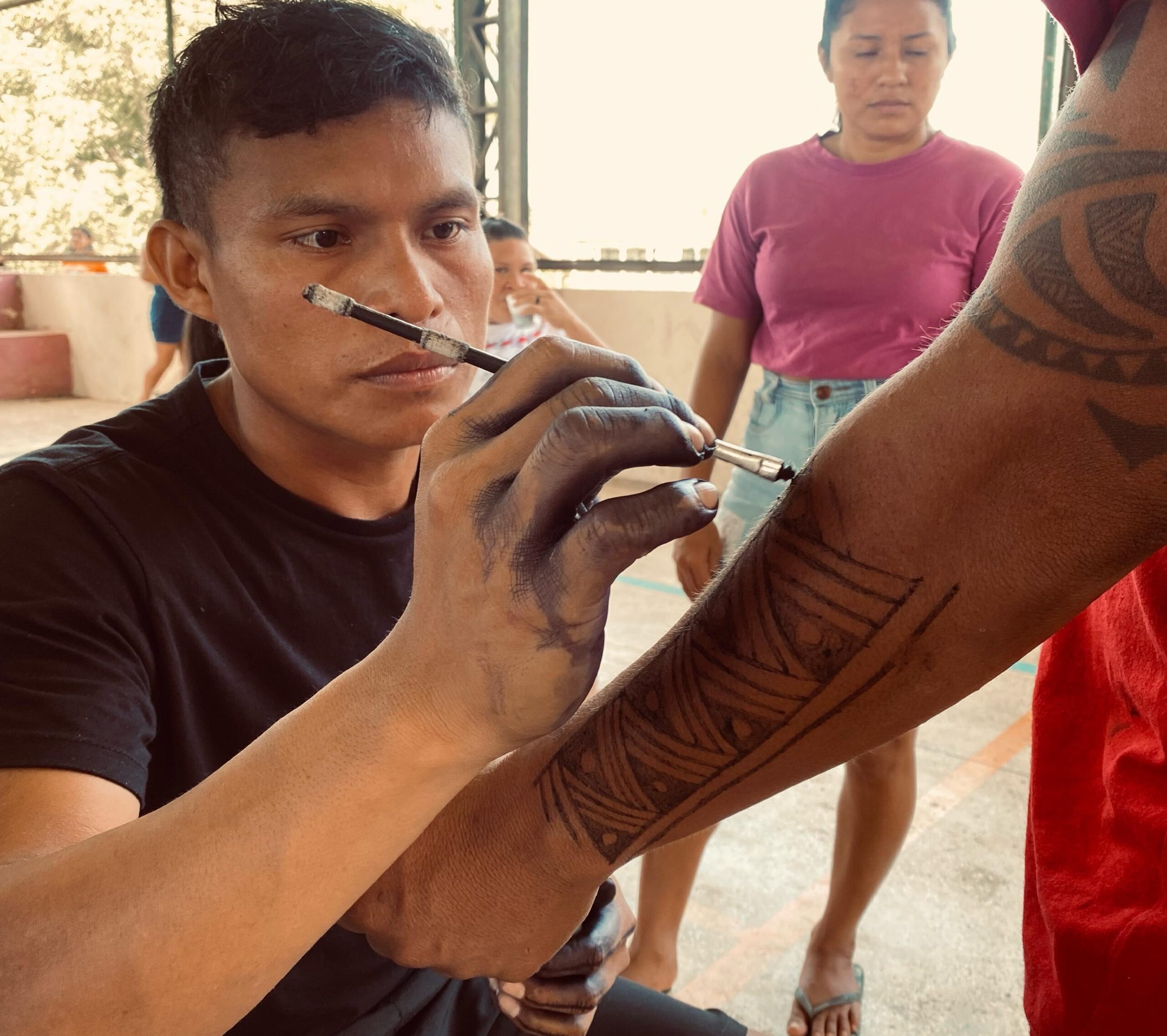
Rosimere Arapaço, Vice-coordinator at Makira-E’ta, one of the organizations working with the SETA Project, speaks on indigenous iconography and its meaning, which serves as a symbol of identity, memory, and cultural expression.
The indigenous symbols carry stories and ethnic belonging. The traditional images are typified by their lines and geometric shapes, which can be applied to different objects and also used as corporeal painting.
In an interview with the SETA Project, Rosimere Arapaço, Vice-Coordinator for Makira-E’ta’s network of Indigenous Women from the state of Amazonas, one of the organizations that make up the alliance within the SETA Project, spoke about the meaning embedded in the images and the racism that the indigenous indigenous population faces.
1. What are the meanings of these body symbols for indigenous people?
The symbols and the corporeal illustrations characterize the identity of each indigenous ethnic group in the nation. It is a form of cultural expression that not only decorates the body but also symbolizes the identity and the resistance of each of these peoples.
The body designs are made with natural ink, derived from plants, tree bark, roots, leaves, and seeds, and can last from 15 to 20 days. Each trace carries a unique meaning. Body art is an essential aspect of personal and collective identity, utilized in rituals, celebrations, and at work.
2: In your opinion, how does society view the indigenous images?
A few decades ago, indigenous groups from several different regions had stopped using the symbols and even their body adornments because of policies during the military dictatorship via what was called “acculturation”.
Today, the use of adornments, designs, and body symbols highlights the existence of indigenous peoples in their territories. These designs are used at work to protect against solar rays, and they are utilized in rituals and festivities for each ethnic group.
Currently, the use of headdresses, iconography, and body designs is how they reaffirm their respective ethnic groups’ individual identity and existence, which have been here far before the arrival of the colonizer in the land of Pindorama.
Society cannot understand the indigenous peoples’ cultural values. It looks upon them with prejudice and racism. The indigenous people are and will always be indigenous regardless of where they may be, be it in their territories, in urban spaces, or in the peripheries of large cities. It was not the indigenous people who sought to live in large cities; on the contrary, the cities were and are still built on indigenous lands.
3: For you, based on the news of racism suffered by two young people on the school campus, why are these situations still present, especially in learning institutions?
Several similar cases have happened in schools. The number of indigenous students who suffer from racism in the learning spaces has only increased, and this occurs due to a lack of awareness, preparation on the teachers’ and principals’ part, knowledge, or simply when violence is incited against indigenous students.
4: In what form does the devaluing of this iconography reveal the structural racism that the indigenous people face daily?
This occurs mainly when the indigenous people are objects of ridicule within public institutions. Be it in schools, hospitals, notary offices, or even in the delegacies while they are filing a police report against any violence suffered. It happens when those who should protect are the ones who commit the crime.
5: What are the psychological and social impacts that these children, victims of racism, can experience because of the iconography and because of their origin?
The psychological impacts are more severe and more pronounced in the child’s life. The child will grow up in fear of the non-indigenous society. Isolation. Dropping out of school. As a result, not only the child but the entire family is impacted.
6: How could antiracist education aid in combating racism suffered by the indigenous people?
Antiracist education needs to be practiced in the schools as well as other sectors of public administration because the school environment needs to be a safe space for everyone. Each of these individuals has their own respective cultural identity.
7: What actions can learning institutions adopt to promote change in this lamentable scenario?
First and foremost, we need to implement policies of respect, and that means providing critical education that includes diversity. In order for this to happen, it is necessary to train teachers to manage scientific, ethnic, racial, and cultural matters. In addition, the principals and teachers need to know how to recognize situations of prejudice and racism and intervene pedagogically when they arise.