Postado em: 9 July, 2026
International Seminar Discusses the Pathways to Strengthening Anti-racist Education in Brazil and in Latin America
Promoted by the SETA Project, the event discusses advances, challenges, and strategies for the implementation of Education for Ethno-Racial Relations
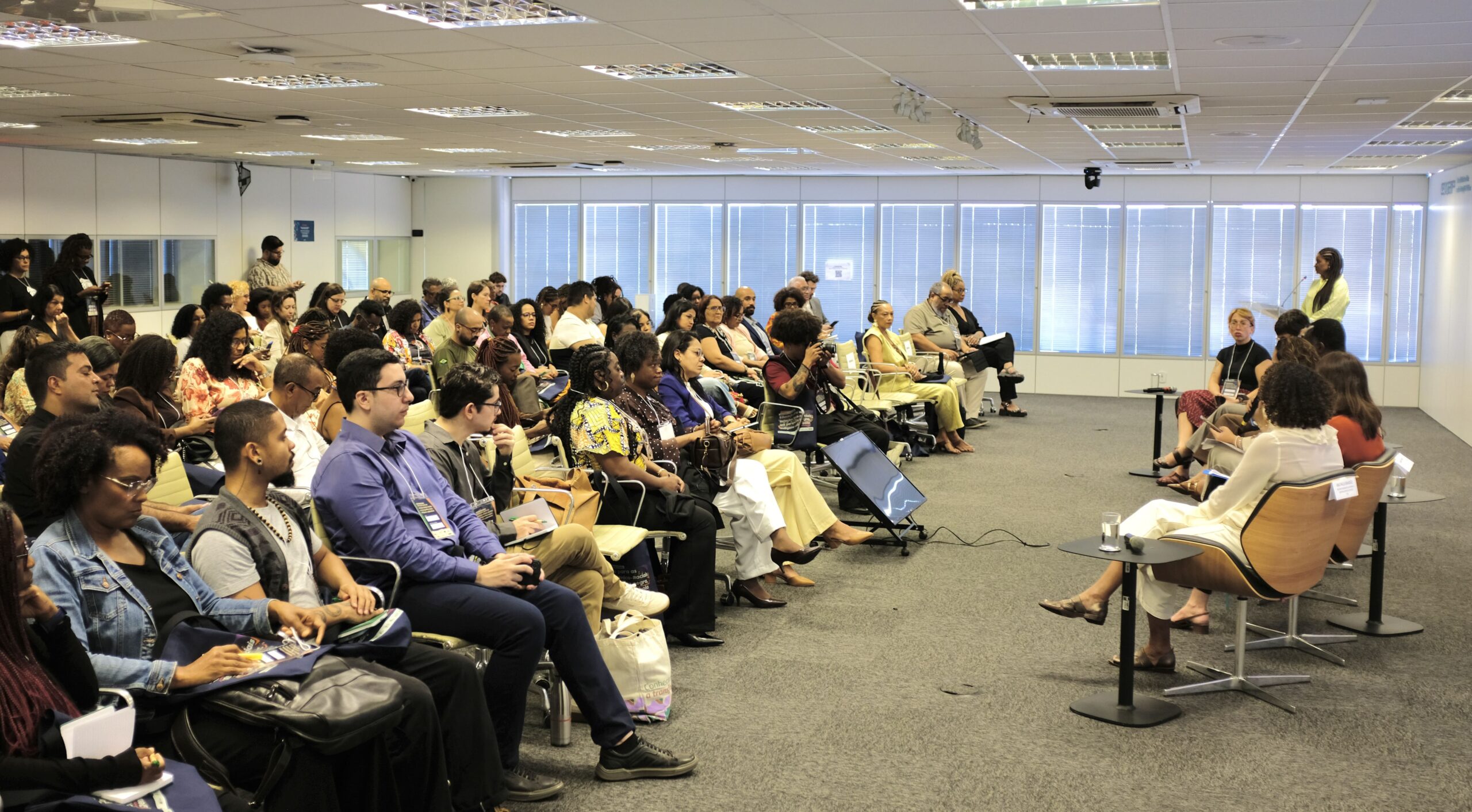
On June 16th and 17th, Brasília hosted the International Seminar on Education for Ethno-Racial Relations: Black, Indigenous, and Quilombola Perspectives. The event was promoted by the SETA Project in partnership with the National School of Public Administration (Enap), the Ministry of Management and Innovation in Public Services (MGI), UNICEF, and UNESCO, the Latin American Campaign for the Right to Education (CLADE), and the Ministry of Racial Equality (MIR).
The conference, held at Enap, gathered representatives from: the government, research institutions, social movements, and international organizations as well as specialists from Brazil, Colombia, Peru, and South Africa to debate strategies aimed at strengthening Education for Ethno-Racial Relations (ERER), for quilombola education and indigenous education.
Over the course of the two-day program, participants shared their experiences, assessed challenges, developed proposals to expand the implementation of public policies committed to racial equity, and reflected on the role of the government and civil society in fostering anti-racist education. The event joined more than 500 registered participants, both in person and remotely.
Diversity, Antiracism, and the Role of Education in Building Democracy
The opening session brought together the panelists Iara Alves (Enap), Clédisson Junior (Ministry of Racial Equality), Monica Dias Pinto (UNICEF), Thais Iervolino (CLADE), Rebecca Otero (UNESCO), and Ana Paula Brandão (ActionAid Brazil/SETA) to discuss anti-racist education as an essential element for building a democratic and inclusive society. The participants argued that combating racism must be understood as a collective and ongoing responsibility, one that directly impacts the quality of education provided in schools.
In this regard, the discussions reinforced the importance of effectively implementing Law No. 10639/2003 and Law No. 11645/2008, which are considered key milestones in honoring the histories, cultures, and contributions of Black and Indigenous peoples within the school environment. Furthermore, the need to strengthen public policies capable of promoting the recognition of ethno-racial diversity was highlighted as an essential component of civic education.
“Antiracist education is a prerequisite for democracy and a condition for ensuring that the histories and contributions of Black, Indigenous, and Quilombola peoples are recognized and valued”, asserts Iara Alves, Director of Executive Education at Enap.
Implementing Racial Equity Policies within School Networks
Featuring Lucimar Dias (UFPR), Givânia Silva (CONAQ), and Danielle Munduruku (UFMA), and moderated by Tania Portella (Geledés), the second panel discussed the challenges of implementing a National Policy for Equity, Education for Ethno-Racial Relations, and Quilombola School Education (PNEERQ). The discussion highlighted the promotion of anti-racist education and the strengthening of indigenous and quilombola school education within school systems.
The panelists stressed that transforming the school curricula, investing in professional development programs for educators, and strengthening the federal governance are key steps in ensuring that anti-racist education moves beyond the regulatory framework and is actually present in the day-to-day reality of the schools.
Similarly, shared practices and tools geared towards the monitoring of the implementation of these public policies were presented, emphasizing the importance of the work coordinated across federal, state, and municipal governments.
“We won’t close the immense gap between white and Black people in the country without addressing the inequalities that are reproduced daily within schools”, underscored Clélia Mara dos Santos, Director of Policies for Ethno-Racial Education and Quilombola School Education at the Ministry of Education (MEC).
Monitoring and Evaluation in Strengthening of Public Policies
The third panel brought together Marleide Nascimento (CADARA), Shirley Pimentel (CONAQ), and Lara Villela (SECADI), and moderated by Vitalina Silva (UNDIME Bahia) to discuss mechanisms capable of measuring the implementation of racial equity policies and their impacts on the territories. The debate reinforced that the production of data, indicators, and evidence are essential for guiding the decision-making, monitoring progress, and increasing the effectiveness of initiatives developed by the school networks.
At the same time, the participants advocated for the development of a participatory evaluation process that involves administrators, teachers, students, and communities in identifying the challenges and the opportunities. Consequently, the monitoring process comes to be understood not only as technical tools but rather tools for strengthening the public policies around anti-racist education.
“When we speak of anti-racist education, we are speaking of high-quality education. If it isn’t anti-racist, then it isn’t high-quality education”, said Ednéia Gonçalves, Executive Coordinator of Ação Educativa (Executive Action).
Latin-American Shared Experiences in Combating Racism
Featuring Luiz Nazareno and Eliseo Cortina (Colombia), Evelyn Buenaño (Peru), and the moderator Thaís Iervolino (CLADE), the panel promoted a moment to discuss shared experiences on the implementation of educational policies geared towards the recognition of afro-descendant and indigenous populations. The debate emphasized that Latin-American countries share similar challenges in guaranteeing the right to education, in fostering racial equity, and in combating structural racism.
On the other hand, speakers highlighted progress made through social mobilization and creating specific legal frameworks. Nevertheless, they underscored the need to expand investments, strengthen teacher training, and ensure the effective implementation of public policies within the communities, fostering a greater integration between governments and civil society.
“Racism continues impacting the educational trajectories of children and the youth throughout Latin America, and it requires joint responses between the governments and civil society”, Evelyn Buenaño highlights, Director of Advocacy and Communication for Save the Children Peru.
The centering of social participation and active involvement of Black movements, a recurring theme throughout the first day discussions – is also reflected in other initiatives supported by the SETA Project. One example is the support for Rio de Janeiro Black Women’s March, an initiative that reinforces the importance of collective organizing in the struggle for rights and racial justice.
Watch the full first day of the seminar.