Postado em: 5 September, 2025
Quilombo of Cafundó welcomes participants from the conference “Learning Experience on Racial Equity 2030”
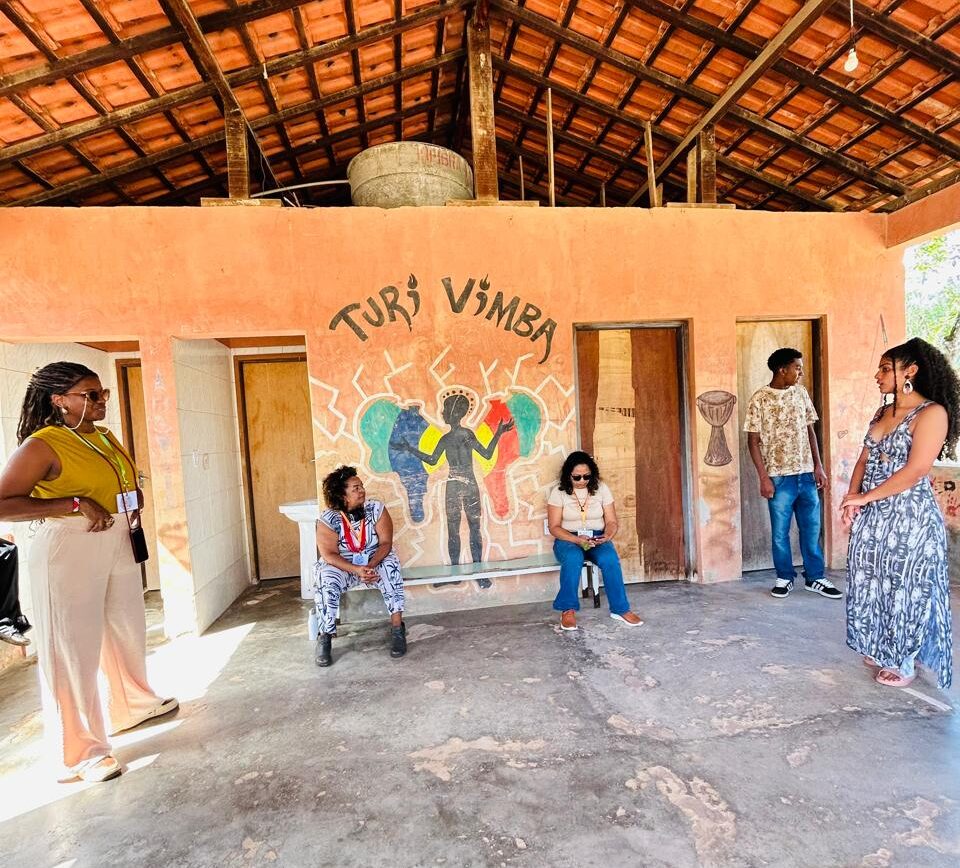
The guests had the opportunity to become familiar with the history of Quilombo of Cafundó and to participate in activities that celebrate Afro-Brazilian culture.
The third day of the conference’s agenda, “Learning Experience on Racial Equity 2030”, promoted by the W.K. Kellogg Foundation, in partnership with the SETA Project, was characterized by a visit to the Quilombo of Cafundó, located in Salto de Pirapora, a municipality 121 km away from the capital São Paulo.
The guests were taught the site’s history and participated in an Abayomi workshop, a doll made from shreds and patches of fabric. These dolls represent Afro-Brazilian resistance and culture. To close the event, the guests enjoyed the styling of the jongo circle, a dance and Afro-Brazilian music genre from the southwest of the country.
Preservation of culture and sustainable development in the Quilombo of Cafundó
The territory is a traditional Afro-Brazilian community that has preserved its cultural heritage and also undertakes innovative initiatives led by the community in order to promote sustainable development.
Givânia Silva, Coordinator for the National Education Collective of the National Coordination of Articulation of Rural Black Quilombola Communities (CONAQ), an entity that is one of the partners in the SETA Project’s alliance, was present during the conference and remembers the moment when the Quilombo of Cafundó reclaimed its land. “I spent nine years in the Federal Government, and this Quilombo was a territory that began to retrieve its land when I was the administrator of this policy. So, to see, today, the residents of this territory continuing this history, for me, is emotional”, she said.
The Need for quality education for the quilombola population
According to the Brazilian Institute of Geography and Statistics (IBGE), there are approximately eight thousand quilombola communities in 30% of Brazil’s municipalities. During her talk, Givânia emphasized alarming data: the quilombola community of individuals aged 15 to 35 is almost three times more illiterate than the rest of the Brazilian population.
“This means that we have two unnegotiable political stances: the regularization of our territory and the guarantee of education, quality education that is truly antiracist and antisexist. For this reason, we can not see them taking down schools, taking our students away to the city, and then we disappear, because when we arrive in the urban zone, we disappear. Our story is not told, no one knows who we are, and when we try to tell our story, we are erased”, she stresses.
The event concluded with participants exchanging experiences and future perspectives
After four days, immersed in a rewarding conference that presented the work developed by the SETA Project to nearly 50 participants, the event’s closure was characterized by a time to exchange experiences and perspectives for the future.
Ana Paula Brandão, Administrator for the SETA Project and Program Director for ActionAid, highlighted the exchange among participants as one of the important points of the conference. “We have listened effectively, because we have traveled a lot. We have conversed with different people from other groups, and I was surprised by the fact that the organizations are becoming increasingly more advanced. In other words, the work is progressing steadily and strongly, which is very good, she comments.
—
The event “Learning Experience on Racial Equity 2030”, promoted by the Kellogg Foundation, in partnership with the SETA Project, gathered in São Paulo, SP, between the 28th of April and the 1st of May. Specialists came to discuss themes related to racial equity. In addition to the guests, the foundation’s international delegation was also present at the conference, and from all of the organizations that comprise the SETA alliance – ActionAid, Ação Educativa (Education Action), National Campaign for the Right to Education, CONAQ, Geledés, Makira-E´ta, and UNEafro Brazil.