Postado em: 10 July, 2026
International Seminar Highlights Monitoring and Centering Youth in the Promotion of Racial Equity in Education
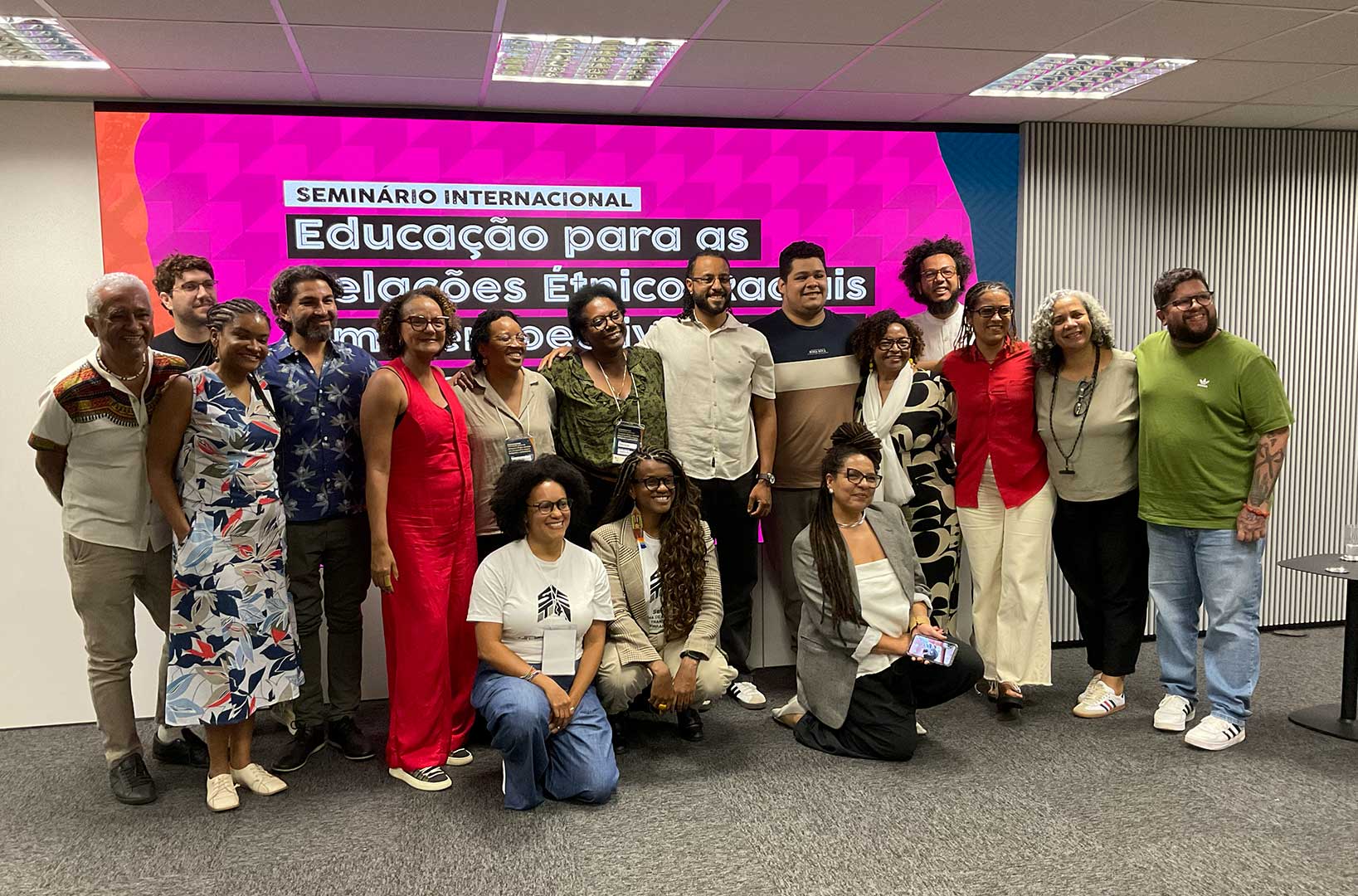
The Second Day of the Conference Further Deepens Discussions on Public Policy Evaluation to Increase the Implementation of Anti-Racist Education
The second day of the International Seminar on Education for Ethno-Racial Relations: Black, Indigenous, and Quilombola Perspectives, promoted by Project SETA expanded the discussions on the challenges and pathways to strengthening the implementation of public policies tailored to racial equity in education.
Bringing together public officials, researchers, social movements, and international organizations, the discussions proceeded on the themes addressed during the opening session. The highlights from the first day can be found here.
Strategies for the Implementation of Anti-racist Education
One of the highlights of Wednesday’s agenda was a panel dedicated to the strategies needed to strengthen the implementation of anti-racist education across diverse national and local contexts. The panel featured Evelyn Buenaño (Peru), Kátia Régis (Ministry of Racial Equality, representing the Caminhos Amefricanos Program), and Zama Mthunzi (ActionAid International/GARJE Project) and was moderated by with Fernanda Rodrigues (UFMA). The conversation explored ways to amplify cooperation among governments, civil society organizations, and educational institutions to promote racial equity and the right to education.
During the debate, participants highlighted the importance of coordinating among social movements, researchers, public administrators, and international organizations to ensure that the education policies are built upon the communities’ realities and the demands of historically marginalized populations.
Furthermore, the participants advocated for centering of experiences generated across the Global South as a pathway towards building solutions that are more deeply connected to the reality of Latin-American countries.
“We need to produce knowledge from the Global South so that our histories are told from our own perspectives”, reinforces Kátia Régis, General Coordinator of Racial Justice and Combating Racism at the Ministry of Racial Equality.
Data, Monitoring, and Learning for Racial Equity
The conference’s sixth panel deepened the discussion on the production and usage of data to drive public policies aimed at racial, gender, and territorial equity. The panel featured Marcelo Perilo (SETA), Wesley Matheus (Ministry of Planning and Budget – MPO), Luciano Pereira da Silva (IPEA), and João Gabriel (UFU/SETA) and was moderated by Luciana Ribeiro (SETA). The participants highlighted the importance of improving information and monitoring systems capable of exposing inequalities, enhancing decision-making, and strengthening the implementation of public policies focused on promoting educational equity.
In addition to the quantitative indicators, the debate highlights the valuing the experiences, trajectories, and narratives produced by Black, Indigenous and Quilombola communities. In this regard, the experts argued that the knowledge production must incorporate both the statistical data and the lived experiences of the individuals impacted by the public policies.
“An evaluation that is committed to racial equity needs to be democratic, intercultural, and able to transform realities”, states Wesley Matheus, National Secretary of Monitoring and Evaluation of Public Policies and Economic Issues at the Ministry of Planning and Budget.
Participatory Self-evaluation as an Instrument of Transformation
The self-evaluation frameworks of the Quality Indicators in Education (Indicadores da Qualidade na Educação – INDIQUEs), a methodology developed by Ação Educativa and currently supported by the SETA Project, was another major high point of the event. The participatory initiative seeks to strengthen the anti-racist practices within schools. The panel featured Monica Pinto (UNICEF) and Ana Lúcia Silva e Souza (UFBA), and was moderated by Edneia Gonçalves (Ação Educativa). The speakers highlighted that evaluation should be understood as a tool for institutional learning, continuous improvement, and the strengthening of school communities.
In addition, they reinforced the relevance of active participation from the students, families, educators, and administration in building more inclusive, democratic, and engaged school environments with racial equity. In this regard, self-evaluation appears to be a strategy capable of transforming pedagogic practices and strengthening the schools’ institutional culture.
“The self-evaluation process allows the school to recognize its challenges, build on its strengths, and collectively advance in building an anti-racist education”, said Ana Lúcia Silva e Souza, a Professor at the Federal University of Bahia.
Black, Indigenous, and Quilombola Youth at the Forefront
With the participation of Herbert Alencar, (Makira E’ta), Joellen Lima (Uneafro Brazil), and Shirley Pimentel (CONAQ), and moderated by Avanildo Duque (National Campaign for the Right to Education), the eighth session highlighted the recognition of youth and adolescents as political subjects capable of contributing to the creation of more just and inclusive educational policies.
The discussions addressed topics such as social participation, strengthening identities, access to education, and creating opportunities for the youth. In addition, the specialists advocated that effective public policies need to consider the experiences and perspectives of the young people themselves, valuing their role in social transformation.
Advances, Challenges, and Next Steps for the SETA Coalition
The closing session brought together Suelaine Carneiro (Geledés – Black Women’s Institute), Avanildo Duque (National Campaign for the Right to Education), Givânia Silva (CONAQ), Herbert Alencar (Makira E’ta), Gabriel Salles (UNEafro Brazil), Ana Paula Brandão (ActionAid Brazil/SETA), and Edneia Gonçalves (Educative Initiative), with Marcelo Perilo moderating. The conference fostered a collective reflection on the progress achieved and the challenges that remain, marking both a half-way assessment of Project SETA’s first four years and a look ahead at the actions that will continue until 2030.
The participants highlighted the value of the crucial role of civil society in securing and strengthening anti-racist educational policies. They supported the expansion of knowledge production, social accountability, combating religious racism, and the collaboration among organizations in Brazil, Latin America, and the Global South.
The strengthening of Indigenous and Quilombola education, the production of high-quality data, and the expansion of international cooperation networks were also identified as priorities.
“Everything discussed here was only possible because civil society, the Black movement, the Indigenous movement, and the Quilombola movement exist”, stressed Ana Paula Brandão, co-executive director of ActionAid Brazil and manager of the SETA Project.
In closing the seminar, the speakers reinforced the need to maintain the collaboration among organizations, social movements, and public institutions to ensure that racial equity policies advance within the territories and reach those who need them the most. Building Latin American networks, strengthening social participation, and defending education as a tool for racial justice emerged as key priorities for the upcoming years.
In this context, Gabriel Salles, coordinator of the Nego Bispo Center of UNEafro Brazil, emphasized that “young people are not just beneficiaries of public policies; they are the protagonists of transformation that we want to create”.
The event reinforces the SETA Project’s role as an important space of political coordination and political advocacy in defense of anti-racist education in Brazil and in Latin America.
“We are not wrapping up. We are only beginning”, concluded Ana Paula Brandão.
Watch the full recording of the seminar’s second day