Postado em: 9 December, 2025
Communication as a Tool in Antiracist Struggles
The SETA Project promotes a parallel event during V CONAPIR
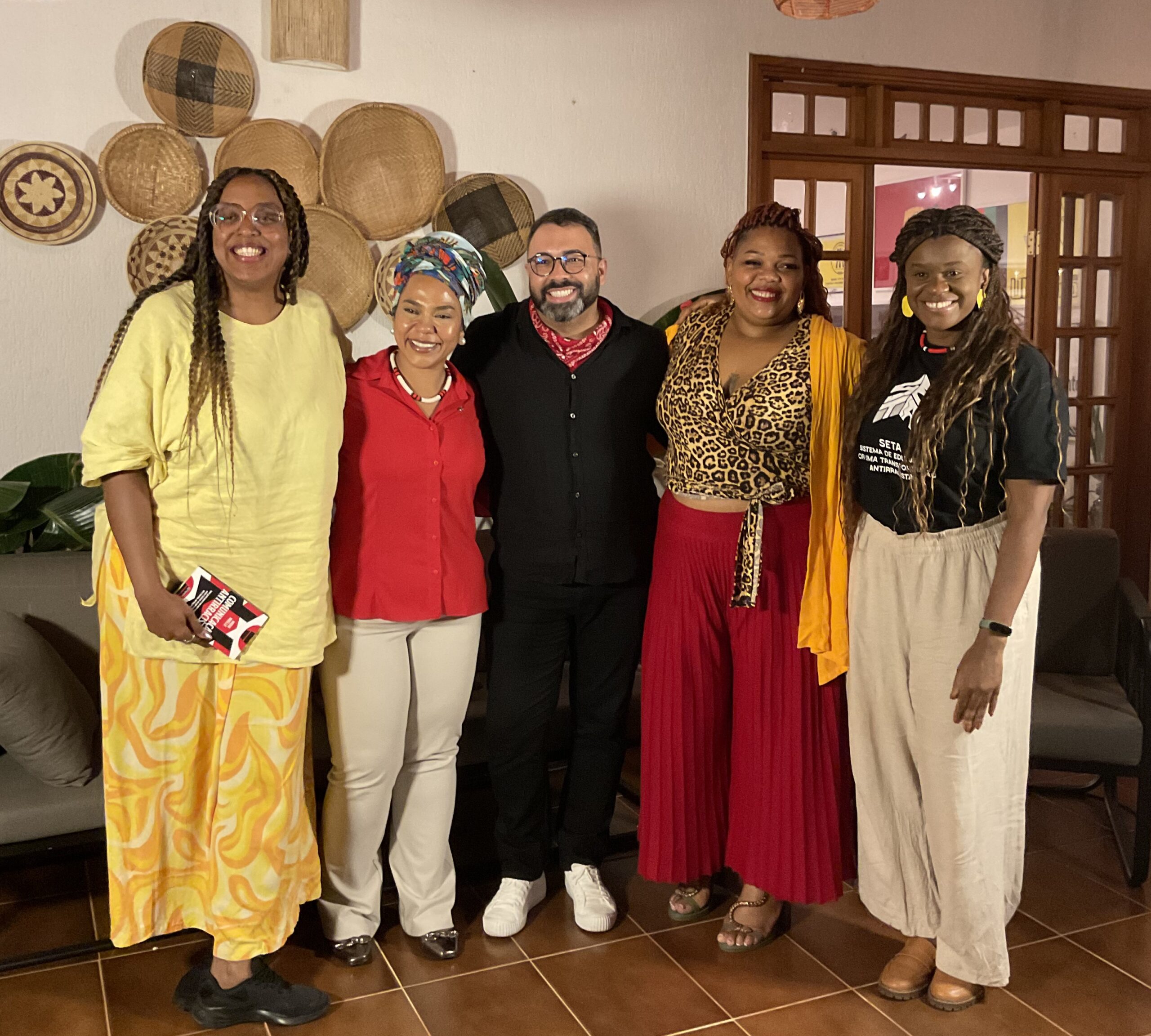
During V CONAPIR (National Conference to Promote Racial Equality), held in Brasilia, in the Federal District, on 16 September, the SETA Project hosted the parallel event “Communication and Social Mobilization for Antiracist Education”. The meeting took place at HUB Peregum.
The roundtable, mediated by Naiara Evangelo, the operational manager and communication adviser for the SETA Project, invited Midiã Noelle, journalist, communicator, author of the book Antiracist Communication, Dandara Tonantzin, Federal Deputy (PT/MG), an activist for socio-political causes of race and education, and Petz Antunes, the publicist responsible for the National Awareness Campaign for Racial Equity in Education in public schools from the SETA Project.
Tools for social transformation
Throughout the event, the guests discussed how they found the field of communication and their decision to work in this professional area. They emphasized that the sector is a political and fundamental educational tool in the antiracist struggle, in addition to addressing the need for planned activities created by black people, and the influence of the social media environment and its ideological alignments in this context.
The publicist Petz Antunes described her decision to work in communications as an act of insanity and rebellion, given that her family wanted her to pursue another professional path. “I was prepared to work in the technology field. However, as I sat in my engineering classes, I noticed that engineering wouldn’t be the area that would give me a source of strength. With that said, I made a snap decision and sought out a degree in publicity, and it was there that I found a space of power”, she commented.
Communication and Politics
The Federal Deputy Dandara Tonantzin raised the question of the importance of the synergy between politics and communication. The parliament member stressed the need to create communication guidelines for the spaces that are being occupied and the importance of black people being present in corporate spaces, as well as aiding in building the strategies behind the narratives.
“I believe that our greatest challenge as a social movement is for us to be able to bring more and more activists from the digital space to our government-focused approach, and also for us to take this approach to online activism”, Dandara reinforces.
Building antiracist narratives in communication
Midiã Noelle addressed one of the greatest issues for communication specialists: the lack of reflection on communication policy. During her speech, the journalist cited the Statute of Racial Equality, which contains passages on the importance of thinking about political communication. According to her, job positions in the Federal Government are subject to rapid change, and people do not understand the permanence of what is already there, regardless of the professions there.
“If we are not able to quantify what we are doing and to define these issues as communication activities, we will get lost politically. We have defined our spaces, but we have not placed importance on the dimension of communication”, she highlights. For her, communication is education, because storytelling teaches.
The roundtable discussion for the event can be checked out, in full, via the link